


Socrates, a towering figure in Western philosophy, left an indelible mark on human thought. His unique method of inquiry, known as the Socratic elenchus, was central to his philosophical approach. This method, famously employed in his Athenian trials, involved rigorous cross-examination. Therefore, understanding the Socratic elenchus is key to grasping his legacy. It was more than just a debate; it was a tool for uncovering truth. Moreover, it shaped the very foundations of philosophical discourse.
The Trial of Socrates: Piety and Corruption
In 399 BC, Athens witnessed the dramatic trial of Socrates. He faced serious charges. These included asebeia, or impiety, and corrupting the youth of Athens. The philosopher’s accuser was Meletus. Socrates, however, did not passively accept these accusations. Instead, he turned the tables on his accuser.
Socrates’ Defense and the Elenchus
Socrates famously employed his elenchus during his trial. This was a form of cross-examination designed to expose contradictions. He questioned Meletus relentlessly. His aim was to reveal the flaws in his accuser’s arguments. While this intellectual sparring was impressive, it did not secure his acquittal. Socrates was ultimately convicted. He was condemned to death by a jury of 501 Athenian citizens.
This trial highlights a crucial aspect of Athenian society. It also underscores the power and limitations of philosophical inquiry in the public sphere. Despite his wisdom, Socrates could not persuade the jury to spare his life. The wisdom of Socrates, though profound, proved insufficient for the task of advocacy in that specific context.
What is the Socratic Elenchus?
The Socratic elenchus is a specific type of argument. It is a method of philosophical investigation. Socrates used it to examine the beliefs of others. He also used it to examine his own beliefs. The core of the elenchus is a series of questions. These questions are designed to lead the interlocutor to a realization. This realization often involves a contradiction in their own stated beliefs. Therefore, it is a powerful tool for critical thinking.
The elenchus is not about winning an argument. Instead, its purpose is to achieve intellectual clarity. It aims to expose ignorance. It also seeks to prompt a re-evaluation of one’s own assumptions. Socrates believed that the unexamined life was not worth living. The elenchus was his primary means of encouraging examination.
Key Characteristics of the Elenchus
- Questioning: The method relies heavily on a series of probing questions.
- Eliciting Beliefs: Socrates would draw out the beliefs of the person he was questioning.
- Identifying Contradictions: He would then reveal inconsistencies within those beliefs.
- Seeking Definitions: Often, the elenchus focused on defining abstract concepts like justice or virtue.
- Leading to Aporia: The process frequently ended in a state of aporia, or perplexity, for the interlocutor. This was a crucial first step towards genuine understanding.
Moreover, the elenchus was not about imposing his own views. Instead, it was about guiding others to discover the truth for themselves. This is why it is often described as a form of intellectual midwifery, or maieutics.
Socrates and the Athenian Context
Socrates was born in Athens in 469 BCE. His father was a stonemason, and his mother was a midwife. He grew up in a vibrant, democratic city. Athens was a hub of intellectual and political activity. However, it was also a society with its own set of beliefs and traditions. Socrates engaged directly with these everyday views and popular opinions.
He spent his life in Athens, not writing down his ideas. Instead, he committed himself to living simply. He also dedicated himself to interrogating the prevailing wisdom. This made him a unique figure. He was a philosopher who lived his philosophy in the public square.
The Peloponnesian War and its Aftermath
The later life of Socrates coincided with significant political turmoil. The Peloponnesian War (431–404 BC) deeply affected Athens. This conflict weakened the city and led to a period of instability. The democratic government faced challenges. Some historians suggest this context contributed to the climate that led to Socrates’ trial. The charges of impiety and corrupting the youth could have been amplified during such uncertain times. Therefore, the political backdrop is crucial for understanding his fate.
Furthermore, Socrates’ philosophical activities sometimes brought him into conflict with powerful figures. His questioning of established norms made him a controversial figure. This was particularly true in a city that prided itself on its democracy and intellectual freedom.
The Socratic Problem: Uncovering the Real Socrates
A significant challenge in studying Socrates is the “Socratic Problem.” Socrates himself never wrote anything. Therefore, our knowledge of him comes from secondary sources. The most important of these are the writings of his students, particularly Plato. Other ancient writers like Xenophon also provide accounts. However, Plato’s dialogues are considered the most comprehensive.
The problem lies in distinguishing the historical Socrates from the characters he represents in Plato’s dialogues. Plato’s own philosophical development also evolved over time. This makes it difficult to pinpoint Socrates’ exact original ideas. However, scholars have worked to reconstruct a close approximation of the historical Socrates.
Sources of Information about Socrates
- Plato: His dialogues, especially “Apology,” “Crito,” and “Phaedo,” offer extensive accounts of Socrates’ life and teachings.
- Xenophon: His “Memorabilia” and “Apology of Socrates” provide a more practical and less philosophical portrayal.
- Aristophanes: His play “The Clouds” satirizes Socrates, offering a comedic, albeit biased, perspective.
- Aristotle: While a student of Plato, Aristotle also provides valuable insights into Socrates’ methods and ideas.
Despite these sources, finding the original Socrates remains a complex endeavor. However, the elenchus stands out as a consistent element across many accounts. It is widely accepted as his primary philosophical tool.
The Purpose and Practice of the Elenchus
The Socratic elenchus served multiple purposes. Primarily, it was a method for ethical and epistemological inquiry. Socrates believed that true knowledge was essential for living a good life. He sought to help people understand what they truly believed. He also aimed to help them understand why they believed it.
The process often began with a question about a moral concept. For instance, Socrates might ask, “What is justice?” The interlocutor would offer a definition. Socrates would then ask further questions. These questions would probe the implications of that definition. He looked for logical inconsistencies or contradictions. This often led the person to admit they did not fully understand the concept.
The Elenchus as a Path to Truth
This state of admitting ignorance, or aporia, was not an end in itself. Rather, it was a necessary step towards genuine knowledge. Socrates famously claimed that he knew nothing. However, he believed that his awareness of his own ignorance was a form of wisdom. This awareness allowed him to pursue truth more diligently.
Moreover, the elenchus was a way to purify the soul. By clearing away false beliefs, one could make room for true understanding. This is why Socrates insisted that the unexamined life was not worth living. The elenchus was his way of encouraging people to examine their lives and beliefs.
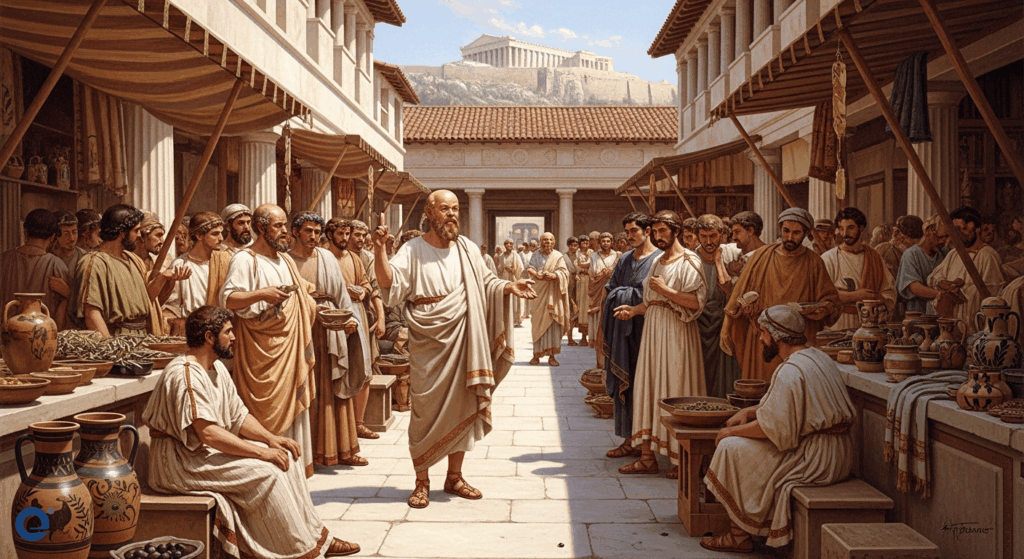
Socrates’ Trial and the Elenchus in Action
During his trial, Socrates’ use of the elenchus was evident. He did not present a conventional defense. Instead, he questioned his accusers and the court. He sought to expose the irrationality of the charges against him. This approach, while philosophically consistent, was not politically astute.
For example, when Meletus accused him of not believing in the gods, Socrates used the elenchus to show the contradiction. He argued that if he believed in divine activities, he must believe in divine beings. This demonstrated a logical flaw in the accusation. However, the jury was not swayed by this logical dismantling.
The Limits of Logic in the Courtroom
The trial of Socrates serves as a poignant example of the limits of pure reason. While the elenchus was a powerful tool for intellectual discovery, it did not guarantee persuasion in a popular court. The jury was composed of ordinary citizens. They were likely influenced by public opinion and political sentiment.
This situation is akin to modern advocacy. The art of persuasion often involves more than just logical arguments. Storytelling and emotional appeal can play significant roles. The authors of one article noted that in advocacy, persuading the tribunal to view facts from your perspective is key. They suggest presenting a case in the form of a story. This is a stark contrast to Socrates’ purely logical approach. In ancient Athens, the effectiveness of pure logic in a public trial was put to the test.
Socratic Themes and Enduring Ideas
Beyond the elenchus, Socrates introduced several profound philosophical themes. These ideas have resonated through centuries of thought. They continue to influence philosophical discourse today.
Key Socratic Principles
- Socratic Ignorance: The recognition of one’s own lack of knowledge is the beginning of wisdom.
- Priority of the Care of the Soul: Socrates emphasized the importance of nurturing one’s inner self over material wealth or social status.
- The Unexamined Life: He famously stated that “the unexamined life is not worth living.”
- Unity of Virtue: Socrates believed that all virtues were interconnected and ultimately amounted to knowledge.
- No One Errs Knowingly: He posited that people only do wrong out of ignorance of what is truly good.
- It is Better to Suffer Injustice: Socrates argued that committing an injustice is more harmful to oneself than suffering one.
These principles highlight Socrates’ commitment to ethics and self-knowledge. They form the bedrock of much of Western ethical philosophy. His influence is undeniable, shaping thinkers like Plato and Aristotle, thus establishing the famous triad of ancient philosophers: Socrates, Plato, and Aristotle. His thought profoundly impacted the trajectory of Western philosophy.
The Legacy of the Socratic Elenchus
The Socratic elenchus remains a vital tool in education and critical thinking. Its principles are applied in various fields, including law, medicine, and education itself. The method encourages active learning and deep engagement with subject matter. It fosters intellectual humility and a commitment to seeking truth.
In modern contexts, the elenchus can be seen in pedagogical approaches that emphasize questioning and student-led discovery. It is a powerful counterpoint to rote memorization. Furthermore, it helps individuals develop the ability to analyze complex issues. This is essential in an increasingly information-saturated world. Therefore, the elenchus is not just a historical method; it is a timeless approach to learning and understanding.
Tóm tắt: The Socratic Method is a process of dialogue, based on questioning, that inspires critical thinking and analysis. Primarily the ……
Frequently Asked Questions about Socratic Elenchus
What is the primary goal of the Socratic elenchus?
The primary goal of the Socratic elenchus is not to win an argument but to expose ignorance and contradictions in beliefs, thereby leading the interlocutor towards genuine self-knowledge and truth.
Did Socrates write down his method?
No, Socrates himself never wrote anything down. Our understanding of his methods, including the elenchus, comes from the writings of his students, most notably Plato. This reliance on secondary sources contributes to the ‘Socratic Problem’.
How did the elenchus relate to Socrates’ trial in Athens?
Socrates used the elenchus during his trial to question his accusers and expose the logical inconsistencies in the charges against him. However, this intellectual approach proved insufficient to persuade the Athenian jury.
What is ‘aporia’ in the context of the elenchus?
Aporia refers to a state of perplexity or confusion that the interlocutor often reaches at the end of a Socratic elenchus. It signifies the realization that their initial beliefs were flawed or insufficient, marking a crucial step towards genuine understanding.
Is the Socratic elenchus still relevant today?
Yes, the Socratic elenchus remains highly relevant. It is a foundational method for critical thinking, education, and philosophical inquiry, encouraging rigorous examination of ideas and beliefs.